
What Does a Black Unicorn in Ruins Actually Mean? 5 Symbols Hidden in This Apocalyptic Art Print
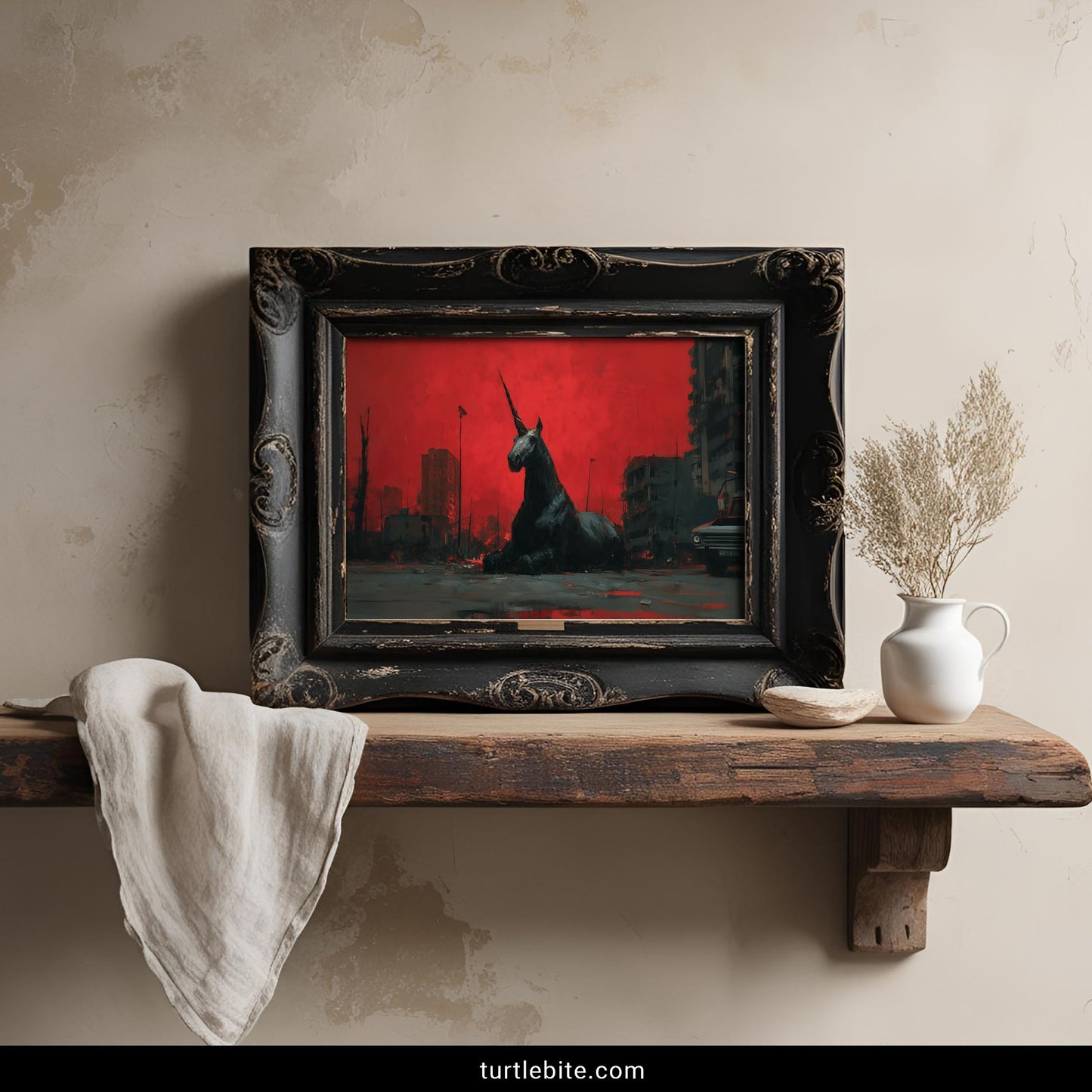
ChristianA black unicorn is resting in the rubble of a dead city, under a sky the color of old blood. No glitter. No rainbows. No hero charging into battle. Just a colossal mythical creature, sitting in the wreckage of the world we built, looking like it has seen things. This image packs five distinct layers of visual symbolism that most people feel before they can name, and once you can name them, you will never look at this piece the same way again.
In this article
- Symbol 1: The Black Unicorn and the Death of Innocence
- Symbol 2: The Crimson Sky as a Warning, Not a Sunset
- Symbol 3: The Urban Ruins as Civilization's Verdict
- Symbol 4: The Resting Pose as Quiet Defiance
- Symbol 5: The Vintage Car and the Collision of Worlds
- Frequently asked questions
Symbol 1: What does a black unicorn actually represent?
The traditional unicorn is white, luminous, and obsessively associated with purity, virginity, and magic in Western folklore. It is practically the mascot of innocence. So when an artist renders one in deep, light-swallowing black, they are not just changing a color. They are inverting the entire mythological contract.
A black unicorn carries all the power and otherworldliness of the archetype, but strips away the reassurance. This is not a creature that will let you pet it if your heart is pure. This is a creature that has watched civilizations rise and collapse, and has drawn its own conclusions. In Jungian terms, it is the shadow side of the ideal: beauty and magic that have absorbed darkness rather than resisted it. It is, weirdly, more honest for it.
The color black in visual symbolism stands for mystery, the unknown, and what lies beyond the threshold of comfortable understanding. Paired with the unicorn's horn (a symbol of singular, penetrating intelligence), you get something that reads as dark wisdom. The creature knows something you do not.

The unicorn you never knew you needed. Colossal, black, and not here for your optimism.
Symbol 2: Why is the sky red, and what does it mean for the mood of the piece?
Red skies in art carry one of the oldest visual warnings in human history. Sailors called it "red sky at morning, sailor take warning" for a reason: the color signals atmospheric disruption, incoming danger, or the aftermath of something catastrophic. In this painting, the sky is not a dramatic sunset. It is the color of something already burned.
The red here is deep and opaque, closer to dried blood than fire. It does not glow. It broods. That distinction matters because a glowing red sky would suggest active destruction: exciting, kinetic, urgent. This red says the destruction already happened. We are in the aftermath. The world is not ending here; it has ended. And the unicorn is still sitting in it, which raises the real question: what does it mean to be a mythological creature in a world that has already run out of myth?
The red also functions as the painting's dominant warm tone, which makes everything beneath it (the ruins, the car, the unicorn's black coat) read as cold by contrast. That thermal tension keeps the eye moving between the sky and the figure, building a sense of unease that is hard to shake even after you stop looking at it.

Symbol 3: What do the ruins tell us about the relationship between civilization and myth?
Post-apocalyptic imagery in art has been doing heavy lifting since at least the Romantic era, when painters like John Martin depicted vast human civilizations crumbling under divine judgment. The ruins in this piece are recognizably modern: concrete, steel, the kind of anonymous urban architecture that could be any city, anywhere. That universality is deliberate. This is not the fall of Rome or Babylon. This is everywhere.
What makes the juxtaposition powerful is what the ruins imply about the unicorn's context. Mythological creatures belong to a world that precedes civilization. They come from the old stories, the ones told before cities, before electricity, before the particular kind of arrogance that builds tower blocks and then abandons them. The unicorn being here, in this wreckage, suggests that myth outlasts modernity. The buildings fall. The creature remains.
There is also a quiet irony baked in: we spent centuries deciding that unicorns were not real, that science and reason had superseded that kind of thinking, that we were beyond fairy tales. Then we built cities, trashed them, and here is the unicorn sitting in the rubble, very much present, while the evidence of our "rationality" falls apart around it. A little embarrassing for us, honestly.
A dark creature holding its ground as everything burns. Same energy, different mythology.
Symbol 4: Why is the unicorn resting rather than fighting, and does that matter?
This is the detail that separates this piece from standard dark fantasy illustration. The unicorn is not rearing up, not charging, not performing dominance. It is sitting. Settled. Its posture reads as stillness chosen, not imposed.
In visual storytelling, how a powerful figure holds its body communicates everything about its relationship to the world around it. A rearing creature is reactive. A fleeing creature is afraid. A creature that simply sits in the middle of catastrophe and looks out at you is something else entirely: it is indifferent to the chaos in a way that suggests the chaos does not threaten it. It has been here before. It will be here after.
This connects to a broader archetype in mythology: the figure who survives not through force but through endurance. There is something deeply subversive about it. We tend to aestheticize violence in dark fantasy. The warrior, the destroyer, the beast unleashed. This piece refuses that. The power here is in the stillness. It is a harder thing to paint, and a harder thing to sit with as a viewer. FYI, that discomfort is exactly the point.

Symbol 5: What does the vintage car in the background actually add to the scene?
Easy to miss, but impossible to ignore once you see it: parked to the right of the frame is a vintage car. Not a futuristic vehicle, not a burned-out shell. A recognizable, grounded, ordinary piece of the 20th century. It is the most mundane object in the painting, and that is precisely why it is doing so much work.
The car anchors the scene in human time. Without it, this could be any fantasy setting: a distant world, an alternate history, a dream. With it, the scene is unmistakably ours. This is Earth. This is a place someone drove to once, parked, and did not come back for. The mythological and the mundane are sharing the same frame, and neither seems surprised by the other.
It also quietly dates the catastrophe. The vintage aesthetic suggests this world has not moved on in some time. The car is not futuristic, which means the collapse did not come from advanced technology. It came from something else. The piece does not tell you what. That ambiguity is part of the design. Dark art that explains itself completely is just illustration. This leaves space for your own reading, and your reading will say something true about you. :)
A colossal creature that belongs to the old world, wandering through a forest that has forgotten it was supposed to be safe.
Frequently asked questions
What is the symbolism of a black unicorn?
A black unicorn inverts the traditional symbolism of the white unicorn (purity, innocence, divine grace) to represent dark wisdom, shadow power, and the beauty that survives corruption. Where the white unicorn belongs to an idealized world, the black unicorn belongs to the real one.
What does post-apocalyptic imagery mean in art?
Post-apocalyptic settings in visual art typically explore civilizational collapse, the hubris of modernity, and what endures after human systems fail. They ask: what is left when the structures we built to make ourselves feel safe are gone? The answer, in this piece, appears to be mythology.
Why do artists combine mythical creatures with urban settings?
Placing a mythological figure in a recognizably modern environment creates a collision of timescales that forces the viewer to question the assumptions of both worlds. The myth asks: was your civilization as solid as you thought? The city asks: are you sure that creature is fictional? The tension between the two is where the meaning lives.
Is dark fantasy art the same as horror art?
Not exactly. Horror art aims primarily at fear and disgust as its emotional endpoint. Dark fantasy art uses darkness as a lens for exploring meaning, beauty, and complexity. It may unsettle you, but its goal is reflection rather than repulsion. The unicorn in this print is unsettling, but it is also, strangely, magnificent.
What makes post-apocalyptic wall art a good choice for home decor?
Beyond the obvious "it looks incredible" answer: art that carries genuine symbolic weight gives a room something to say. A piece with layered meaning rewards repeated viewing in a way that a decorative print simply cannot. Guests will ask about it. You will keep noticing new things. That is a better return on wall space than a motivational quote, IMO.
Own the one that started this conversation
The Dark Unicorn Apocalyptic Art Print ships worldwide from $16.
Get the Print →Fast worldwide shipping. Produced locally near you.